Monday, 11 July 2016

Wearable Products Innovative Side That Make Lives Better

Wearable device manufacturers are seen expanding their reach to change how many carry out their day to-day chores. 

Wearable Technology: Allied Market Research
https://www.flickr.com/photos/scobleizer/5455106314

Wearable electronic products that are found useful by medical practitioners and other sectors are proliferating among consumers worldwide. Aspiring wearable designers and intelligent component manufacturers are finally benefitting from the wearable technology market say researchers at the Allied Market Research (AMR). Furthermore, information technology, security companies as well as third party enterprises including health insurers are making huge profits from the recent developments in the wearable technology market.
Industry experts eyeing the size and share and demands in the sector emphasize that increasing consolidation, especially in the hardware segment will presage a higher emphasis on the development of wearable software. Besides this, the tech stocks are expected to be the robust performers in the low progressive and low inflation industry environment. According to industry experts at AMR, the wearable electronics industry is valued at $25.19 billion by 2020. Furthermore, this sector is anticipated to register a CAGR of 26% from 2014 to 2020. Moreover, the corresponding volume of the wearable electronics market would be about 142.6 million units, growing at a CAGR of 23% from 2014 to 2020.
Watch which wearable technology market players caught attention in 2016

Future wearable technology market  

The wearable technology market is witnessing a significant growth worldwide, especially in the United States. If we are to believe the figures presented by officials at the Fidelity International the global shipment of the wearable products for the 1st quarter in the last year had reached approximately 11.4 million units, which was an increase of 200% compared to the stats in 2014. Of those 11.4 million about 7 million alone were advanced fitness bands, a segment which is anticipated to fuel the future growth of the wearable technology market. Researchers reveal that the development of these wearable products will continue and potentially overshadow both smartphones as well as the tablet in the next five to six years. ears.
For the wearable technology market to continue its growth, product designers will have to become more proficient and combine analytics, big data as well as cloud storage to deliver important insights to the customers at the right time. Besides this, gadgets will be designed by considering the user’s requirements. This process is termed as the human – centered design. Once made possible, the wearable products can soon emerge as an important part of our everyday life. The most significant wearable investment opportunities made so far are in data security, hardware, software, and others.

Wearable technology market is definitely making winds


Courtesy: PwC 2014 survey

What is the future of healthcare wearables?

The wearables in the healthcare industry are definitely one of the big futures. Change is happening in the healthcare, said - Erik Jacobson, working with Accenture at the “IOTSWC15” event. One of the key enablers of the wearable technology in the healthcare sector is the customer expectations. The economic model that works both in the government systems and private systems. e.g. in the UK, the GP is getting high financial control over their trade or business; large B2B agreements between healthcare institutions and payers around operations etc. is fueling the growth of wearable products in the healthcare sector.

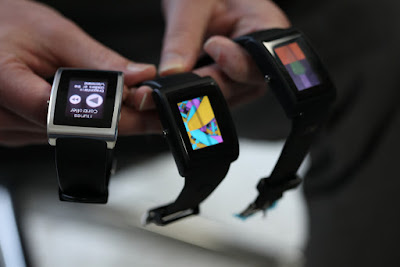
Another focus area is value-based health, where a customer doesn’t just want to pay for the products but also for the end results. Wearables in healthcare can be considered as an endpoint of technology such as a smartphone. When we talk about wearables many will instantly think of a pair of smart glasses or probably a smart watch. But what’s next? Fitness bands are the obvious ones. The fitness market is incredibly mature attending to an array of fitness concerns. Next are the identity bands and the smart clothing or connected clothing which is the next stage of wearables.

Smart wireless necklace wearable music device:Necksound

Necksound is a necklace shaped high quality audio system with a modern and sporty design. Listen to your music while doing sport!


Necksound is a smart wireless wearable that revolutionizes the experience of listening to music and doing sport.
It is a necklace-shaped audio device made with hypoallergenic silicone, with a modern and sporty design that provides top quality sound. Listen to music or talk on the phone while doing any type of physical activity without the need for headphones. Necksound is the perfect wearable to enjoy your private soundscape without being isolated from the world that surrounds you.
Unlike other conventional headphones and hands-free devices, Necksound offers a different, safer and functional alternative. It’s the only device of its kind that combines all essential features.

Friday, 8 July 2016

Digital Signage Hits The Road To Save Lives

Digital signage is taking a turn for the safety lane in an innovative new concept that would see semi trucks providing a heads-up on oncoming traffic to following drivers.
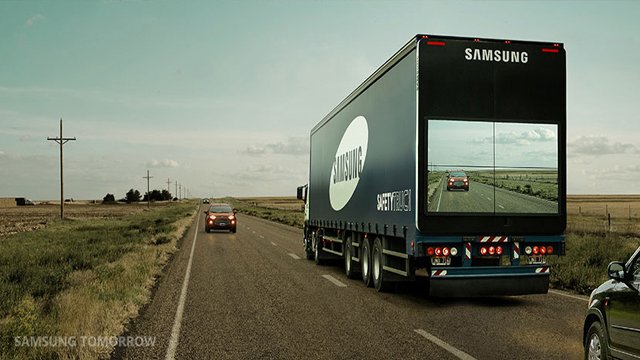
Display technology from Samsung recently was used in a prototype "Safety Truck" aimed at preventing traffic accidents and fatalities from drivers trying to overtake and pass semitractor-trailers in Argentina. The two-by-two video wall mounted to the back of a trailer showed drivers behind the truck what was in front of the truck and any oncoming traffic.

The global display provider wrote about the project in its blog:
Have you ever found yourself driving behind a semitrailer truck? If you're on a single-lane highway or road, it can be a nightmare. Even though the truck is driving relatively slowly, you cannot overtake it due to its size, and because you cannot see what is happening in front of the truck.
However, Samsung has developed a solution that may make this problem a thing of the past.Argentina's statistics on traffic accidents are among the highest in the world, with most of these accidents occurring on two-lane roads and particularly in situations of overtaking. With this in mind, Samsung developed a technology for trucks that seeks to enrich the lives of people through innovation. But more than that, this time the goal is more ambitious: to save lives.
How does it work?
The Safety Truck consists of a wireless camera attached to the front of the truck, which is connected to a video wall made out of four exterior monitors located on the back of the truck. The monitors give drivers behind the truck a view of what is going on ahead, even in the dark of night.
This allows drivers to have a better view when deciding whether it is safe to overtake. Another advantage of the Safety Truck is that it may reduce the risk of accidents caused by sudden braking or animals crossing the road.
Samsung led the prototype development by providing large format display samples, and conducted a test with a local B2B client 

Monday, 4 July 2016

Smart Transportation Ideas Reshaping Your Life

Surge Pricing for Parking Meters


Cheap downtown parking in Philly is both popular and insidious: The glut of circling drivers searching for $2-an-hour street spots means slower traffic, more road rage and worse air quality. The Parking Authority should take a page from the Uber playbook — as San Francisco and Pittsburgh have — and bump prices substantially, to around $7 for prime spots at peak times. This would change the supply/demand dynamic, leading to more open spaces. “Prices should be low enough not to discourage people who are coming in to go to a restaurant or shop, but high enough to discourage people from feeding the meter all day,” offers Rina Cutler, senior director at Amtrak and Michael Nutter’s former deputy mayor for transportation. For those all-day parkers? Off-street parking (a.k.a. garages and lots) with set half-day and day rates will take on a whole new luster.

Thursday, 30 June 2016

Sweet Tear Sensor Could Ease Pain of Diabetes

People with diabetes may soon benefit from pain-free blood glucose monitoring, thanks to a sensor that measures the sugar in tears.
Current techniques for glucose self-monitoring involve drawing blood onto disposable test strips and analysing the samples with a separate device. This painful, multi-step approach deters some patients receiving insulin therapy from testing their glucose levels as often as is recommended. A team from Arizona State University in the US believes that its non-invasive method would encourage diabetes patients to test their glucose levels regularly.
The concept of using tear glucose levels as an indicator of blood glucose is not new. However, it has been tricky to realise because of the small volumes involved and the potential for inconsistent sampling, which make it hard to reliably correlate the results with blood glucose concentrations. Jeffrey La Belle and his team have tackled this engineering challenge to design a device which combines a quick and simple sampling approach with a detector that is sensitive enough to give accurate measurements in vivo.
The result is a prototype ‘Touch’ sensor, which requires only 5.8μL of tear fluid. A disposable soft foam tip absorbs tears by touching the eye ‘for a fraction of a second’, its creators explain. La Belle is reassuring that the method is easy to use: ‘If the person has worn contacts, they are touching their eye more than they ever would using our device.’

Wednesday, 29 June 2016

Dresses That Literally Lit Up the 2016 Met Gala

No contest here: Claire Danes was Cinderella at the 2016 Met Gala. And it Zacwas Posen who was responsible for dreaming up her sweeping pale blue masterpiece of a ball gown and bringing it to life. In true fairy tale fashion—that, by the way, was so in line with the theme "Manus x Machina: Fashion in an Age of Technology"—the dress lit up on the red carpet. 
Woven with fiber optics, the custom Zac Posen dove gray organza gown was the result of "technology meets fantasy" sourced from France. It was truly magical at every single turn
Also magical was Karolina Kurkova's Marchesa masterpiece, which was designed by the design duo Georgina Chapman and Keren Craig, but powered by IBM. Yes, the tech company. The two brands joined forces to create a cognitive dress that exemplified wearable tech at its finest. How it worked: For every tweet that hashtagged #CognitiveDress, IBM's cognitive technology dubbed "Watson" analyzed, broke down the emotion or sentiment behind it (which was assigned a color), and lit up the 150 LED lights embedded in the 3-D flowers embroidered throughout the dress. (The following five sentiments were assigned: joy, passion, excitement, encouragement, and curiosity.) In Jeff Arn's words, the marketing manager of IBM's Watson, what we saw is "a dress that's reactive and responsive to what people are saying about it." We like to think of it as a mood dress. 
"Marchesa is an emotional brand and I feel like this dress is reacting to emotion and it’s changing with emotion. At first what seems like a foreign idea actually seems like the perfect marriage now," Chapman tells us. "The normal perception of technology is far from the Marchesa DNA and in fact, creatively, it was an exciting project. We’re a brand of fantasy and what is more fantastical than technology and where it takes us."
Source:http://www.instyle.com/fashion/2016-met-gala-light-up-dresses-technology

Sunday, 26 June 2016

Quantum Effects Are Key To DNA Electronics

Could the molecule of life become the molecule of electronics? Scientists have taken another step towards making it a reality. Cathal O'Connell reports.

The patterns of DNA base pairs, which code our genes, can also be used to tune the flow of electricity, American researchers have found.
The work could one day lead to DNA-based electronics, made of components much tinier than those squeezed on to current silicon-based computer chips.

In Nature Chemistry today, a team led by Nongjian Tao at Arizona State University describe how the pattern of bases (A, C, G or T) can make electricity flow as smoothly through DNA as through a metal wire, or in hopping steps more like semiconductors.

The insight relies on exploiting the quantum nature of the electron – hence determining whether electrons act like waves or particles as they move through a DNA strand.

For decades, engineers have been cramming more and more circuit elements on to computer chips by making the individual components, such as the transistor “switches”, smaller.

The problem is, this shrinkage can’t go on forever. Eventually, you reach a limit where neighbouring transistors interfere with one another. To go beyond silicon, scientists are looking towards making electronics from individual molecules.

And DNA is one of the most promising molecules for building electronics, being first discovered by nature 3.8-odd billion years ago.

The key advantages of DNA are its stability and the way it can be programmed to assemble into predesigned structures. In 2009, for example, scientists used DNA as a kind of circuit board for assembling electronic components six nanometres apart – much tinier than current silicon processing allows.

DNA also has interesting electrical conductivity, although its measured properties have varied in a somewhat mystifying way.


In 2014, for example, scientists developed DNA-based wires showing it can conduct electricity a bit like metals.